Movie Theater & Cinema Roofing
Commercial Property Roofing for Fort Worth buildings: movie theater & cinema roofing is reviewed through roof condition, drainage, flashing, access, warranty status, and budget timing.
The Auditorium Span Is the Whole Story
A cinema is a building made of big empty boxes. Each auditorium needs an unbroken ceiling with no columns interrupting the sightlines or the sound, which means the roof deck spans 80 to 150 feet across every house. Stack eight, twelve, or sixteen of those boxes side by side and you have a roof built on a structural premise that has nothing in common with the strip retail next door. Fort Worth's exhibition footprint runs from the multiplexes anchoring the Hulen and I-20 retail districts on the southwest side, to the entertainment boxes out along North Tarrant Parkway and the Alliance Town Center area, to the older houses near downtown and on Camp Bowie. They share a problem: long, deflecting decks that a template fastening pattern will not hold.
That deflection is the engineering crux. As a long span moves under wind and thermal load, the membrane attachment at the seams takes concentrated stress that a retail-grade pattern was never designed to carry. So we specify fastener density and insulation attachment off the actual deck — its type, gauge, and rib depth — and we pull-test before committing to mechanical attachment. Where the span makes point loads a concern, we look at adhered or hybrid systems to spread the stress instead of concentrating it at fastener rows.
A Penetration Cluster That Rivals a Hospital
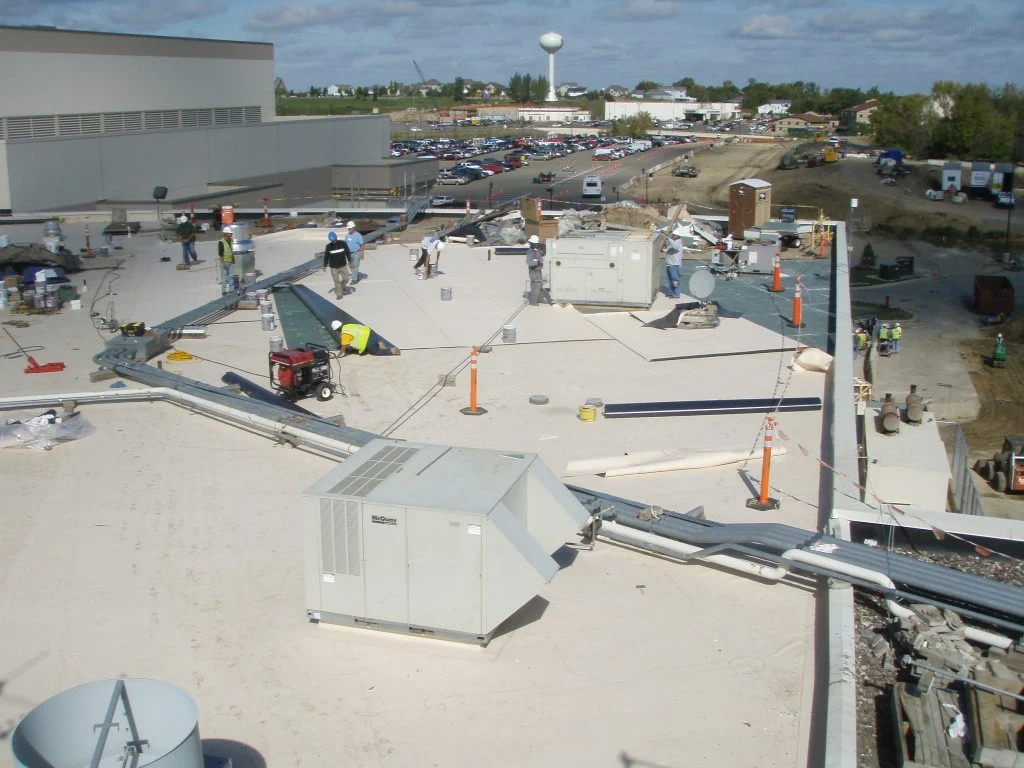
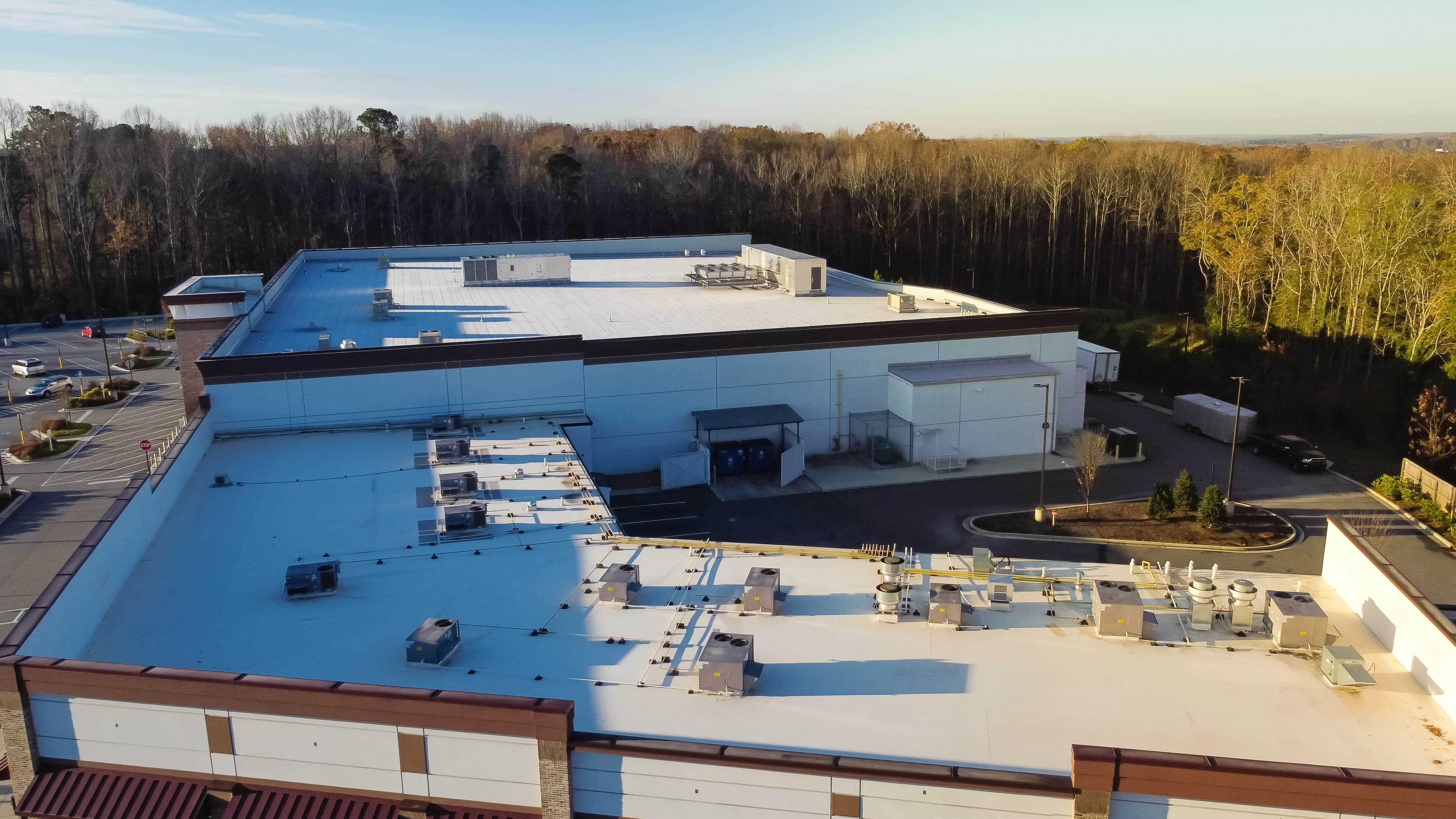
The other thing that makes a cinema roof its own animal is the sheer count of rooftop equipment. Each auditorium typically gets its own dedicated air handling, because you cannot run one system across houses that fill and empty on different showtimes. Add the concessions exhaust, the lobby heating vents, and the condensers for the walk-in coolers behind the snack bar, and the cluster over a busy multiplex starts to look like what you would find on a data center or a hospital. Every curb, every duct boot, every conduit run is an individual flashing detail, and every one gets documented and re-flashed before new membrane goes over it. The acoustic isolation that keeps one screen's soundtrack out of the next house also means mechanical units and their curbs are spread across the roof rather than ganged in one tidy zone, which spreads the detail work out too.
- Steel deck over structural steel: The common cinema build-up. It accepts mechanical attachment directly, but only at a fastener pattern matched to the rib. Older short-rib deck has lower pull-out values than modern 3-inch rib, and we verify which one we are on before we spec.
- Concrete deck: Calls for adhered or, where loads allow, ballasted systems rather than a fastener field. We core first to confirm the layers underneath.
- Reroof candidates: Every theater reroof starts with a core sample to read existing insulation layers, moisture content, and total weight-in-place before we decide between a recover and a full tear-off.
Drainage Is the Quiet Failure on Old Theater Roofs
Big flat decks built decades ago almost never drain the way they should anymore. Years of equipment changes and minor structural settlement leave low spots that pond after every storm, and standing water is what shortens a membrane's life faster than anything else in the North Texas climate. On most multiplex reroofs we design tapered polyiso to re-establish positive slope to the drains. It adds cost, but eliminating the ponding is usually the single biggest extension of service life we can deliver. White TPO over that taper also satisfies the cool-roof energy provisions most jurisdictions now apply to commercial reroof permits, and we add reinforced walkway pads on the heavy traffic lanes between rooftop units so service crews stop wearing out the membrane on foot.
Drainage on a cinema is also complicated by the structure itself. The long-span joists deflect at midspan under load, which means the natural low point on each auditorium bay often sits away from where the original drains were placed. We map the actual ponding pattern during the roof walk, then locate drains and design the taper to match how the deck really behaves rather than where a drawing assumed water would go. Overflow scuppers and secondary drains get verified at the same time, because a clogged primary drain on a flat theater roof can pond hundreds of pounds of water over an occupied auditorium before anyone inside notices.
Working Around the Show
Cinemas run afternoon through late night, seven days a week, which puts them in the same scheduling bracket as a 24-hour building. We plan the work around the screening calendar: tear-off and dry-in are sequenced so every roof section is watertight before the evening shows start, and any HVAC shutdown needed for curb or penetration work is coordinated with the facilities team in advance. Loading-dock access for HVAC service contractors, the electrical conduit feeding the marquee, and evening foot traffic near the entries all factor into how we stage the crew so roofing work never collides with opening procedures.
The entry canopy and the marquee are easy to overlook and a frequent source of chronic leaks on older houses. Anywhere a sign support or canopy framing penetrates the membrane, we treat it as its own flashing item rather than rolling it into the field. The canopy-to-building transition over the entrance sees constant thermal cycling and differential movement, and we evaluate and re-flash it on every cinema project rather than assuming the field membrane fixed it.
Common Questions About Cinema Roofing
Most often 60-mil or 80-mil TPO mechanically attached over tapered polyiso. The taper corrects decades of accumulated drainage problems, white TPO meets cool-roof permit requirements, and we add reinforced walkway pads around the rooftop units.
We verify deck type and gauge, then set a fastener pattern and pull-test it for the actual rib depth. Where deflection makes point loads a concern, we move to an adhered or hybrid system so stress is not concentrated at the seams.
Yes. We plan around the screening schedule, sequence tear-off and dry-in so each section is watertight before evening shows, and coordinate any HVAC shutdown windows with facilities ahead of time.
Yes. Sign and canopy penetrations are individual flashing items in the scope, and the canopy-to-building transition — a common chronic leak point on older theaters — is evaluated and re-flashed as part of every project.