Convenience Store Roofing in Arlington, TX
Commercial Property Roofing for Fort Worth buildings: convenience store roofing in arlington, tx is reviewed through roof condition, drainage, flashing, access, warranty status, and budget timing.
Convenience Store Roofing for commercial buildings across Arlington.
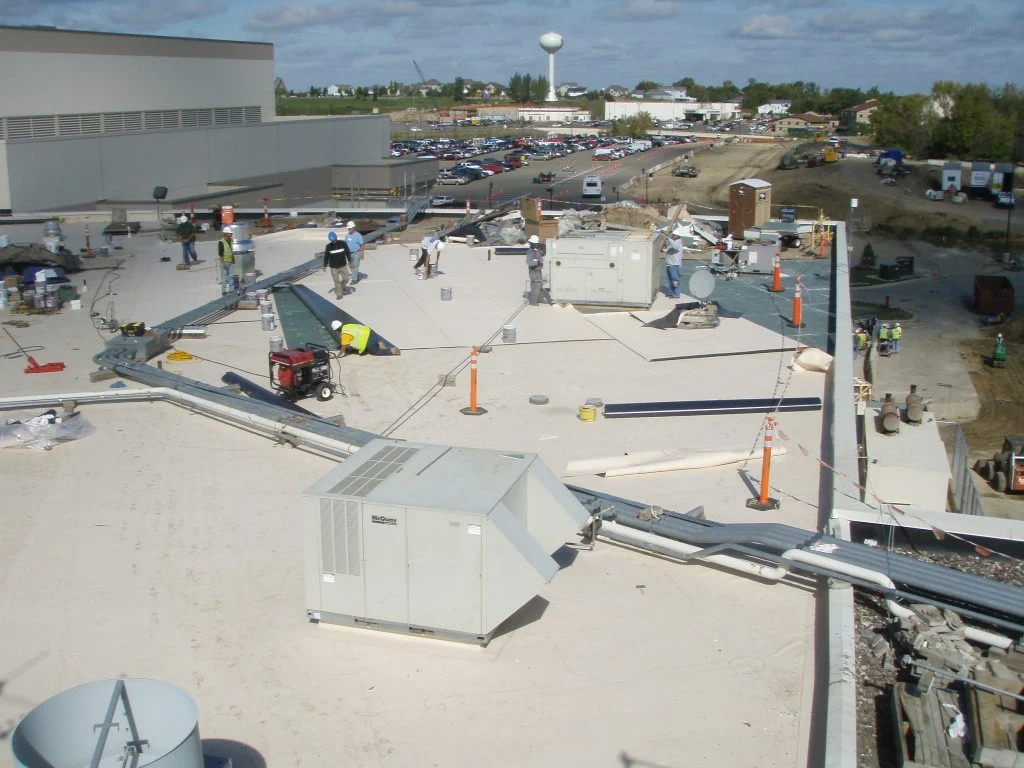
The AllianceTexas industrial park sits about 25 miles north of our downtown office. It is one of the largest master-planned industrial developments in the country, and the warehouse roofing up there is in its own category. Buildings at 500,000 to 1,100, a 40,000 square-foot retail building does. You are managing a crew that can be a quarter-mile from the roof hatch, working in Fort Worth summer heat at 160°F membrane surface temperature, sequencing around dock doors that are open 20 hours a day.
BNSF Railway's Alliance intermodal facility moves freight through that same corridor, which means trucks, rail transfers, and logistics operations that do not stop for a roofing project. The buildings adjacent to BNSF's Alliance yard — the ones feeding directly into the intermodal network — are especially constrained because access roads shift around freight staging. Our project managers walk that access situation before we ever sign a contract.
We run large-deck warehouse work on mechanically attached TPO 80-mil as our standard specification in this corridor. The 80-mil gives us better puncture resistance under rooftop HVAC equipment traffic, longer warranty terms (up to 25 years from manufacturers like Carlisle and Johns Manville), and more margin against the hail exposure that runs through North Tarrant County every spring. Wind uplift on a building that long and that exposed to the northwest wind corridor off the Llano Estacado requires fastener density calculations you do not just borrow from a standard spec sheet.
How We Sequence Work on an Operating Warehouse
Every large warehouse project starts with a sequencing map. We divide the roof field into zones — typically 50,000 to 80,000 square feet each on a million-square-foot building — and assign each zone a start date, an end date, and a crane or material-lift access point that does not conflict with dock door traffic. The building's facilities manager gets a calendar that they can post in their operations center. Dock supervisors know which loading doors are near active work zones on any given week.
Dry-in protocol is non-negotiable on any building that has active inventory inside. We tear off only what we can cover before end of shift. Each zone section gets a temporary single-ply lap fastened before we pack up. On AllianceTexas-scale buildings where the daily production area is large, we maintain a dedicated dry-in crew that follows the main tear-off crew by two hours so there is never an uncovered gap going into sunset.
Night and early-morning shifts are common in this corridor because the summer heat is a real production constraint. Membrane welding quality degrades when ambient temperature climbs above 95°F and the deck surface is radiating heat upward. We schedule membrane installation for 5 AM to noon in July and August, pivot to insulation and substrate prep in the afternoon when the deck is hottest, and bring the welding crew back in the evening if the building's operations allow it.
TPO 80-mil Mechanically Attached — Why This Spec on North Fort Worth Warehouses
Mechanically attached TPO eliminates the adhesive entirely. On a flat metal deck spanning hundreds of thousands of square feet, adhesive application is labor-intensive, temperature-sensitive, and introduces more variables than a facility manager wants on a 25-year asset. Mechanical attachment with FM-approved fasteners and plates at manufacturer-specified pattern density installs faster, performs more predictably under thermal cycling, and is auditable by the manufacturer warranty inspector on a seam-by-seam basis.
80-mil over 60-mil adds less than a dollar a square foot to installed cost on a large project. For a 600,000-square-foot building, that is a meaningful absolute number — but it extends the manufacturer warranty term by 5 years and eliminates a significant category of puncture claims. AllianceTexas buildings see frequent rooftop traffic from HVAC technicians servicing roof-mounted units, and punctures at penetrations and equipment pads are the leading failure mode on 60-mil systems in high-traffic environments.
Tapered insulation design on a warehouse this large requires a civil-level slope-to-drain calculation. We engage our manufacturer's technical representative on every project over 200,000 square feet to verify that the drain layout, the tapered insulation package, and the field-slope plan work together. A warehouse with poor drainage design will pond water at mid-field on a 1,000-foot run, and ponding at that scale accelerates membrane degradation in ways that void the warranty.
Scoping a Fort Worth warehouse roof replacement?
We will walk the full deck, produce a sequencing plan that works around your loading operations, and deliver a scope with manufacturer warranty path and production schedule.
Convenience Store Roofing in Arlington, TX covers a small footprint — typically 2,500 to 4,000 square feet — but the mechanical complexity is disproportionate to the roof area. Refrigerated case condensate, reach-in cooler vents, HVAC units serving the food service area, and fuel system exhaust penetrations all concentrate in a small membrane field. Flashing failures at any of these points create interior damage that can trigger health code citations, environmental review, or customer-facing operational shutdowns.
Fuel pump canopy-to-building transitions are the most common failure point in convenience store roofing. The canopy drains independently, but its roof line connects to the main building envelope at a transition flashing that is exposed to fuel vapor condensation, thermal cycling, and vehicle traffic vibration. Convenience store roofing inspections in Arlington always prioritize the canopy transition detail because deterioration there often precedes interior leaks that the store manager attributes to a different area of the roof.
National brands operating in Arlington — including 7-Eleven, Circle K, Wawa, Sheetz, and regional chains — have corporate roof standards and approved vendor programs that govern how convenience store roofing work is documented, permitted, and closed out. Owner-operators of independent convenience stores in Arlington face the same mechanical penetration challenges without the national account support structure. Commercial Roofing works with both groups, providing the documentation and scope detail that satisfies corporate procurement and the straightforward field review that independent operators need.
Convenience stores in Arlington operate 24 hours a day, which means convenience store roofing work is planned around the fuel delivery schedule, night-shift operations, and the food service prep window. Drainage at areas near vehicle traffic zones must be checked during every convenience store roofing inspection because asphalt sealer, tire debris, and fuel residue can block roof drains and scuppers that are otherwise in good condition.
Call or email to discuss convenience store roofing for your Arlington location. We provide a roof scope that accounts for fuel canopy transitions, refrigeration penetrations, occupancy schedule, and the documentation your brand or lender may require.
Questions Owners Ask
The fuel canopy-to-building transition flashing is the most common failure point. Thermal cycling, fuel vapor condensation, and vehicle vibration degrade this joint faster than the field membrane.
We schedule work during the lowest-traffic window, typically overnight or early morning, and coordinate with the store manager to keep entrances, fuel access, and delivery areas clear during the roofing work.
Yes. Chains like Circle K, 7-Eleven, and others require approved contractor credentials, product data sheets, and a documented scope that matches their corporate facility standards before approving any roofing work.
At minimum twice a year, with extra attention after storm events. The penetration density on a convenience store roof creates more potential failure points per square foot than most commercial building types.
Frequently Asked Questions
How do you handle BNSF-adjacent site access at AllianceTexas?
We pre-walk access routes with the building's facilities manager before contract. On buildings directly adjacent to the BNSF Alliance intermodal yard, freight staging can shift daily. We identify two or three potential crane or material-lift staging areas and build the sequencing plan around whichever one the building can reliably keep clear. We have never had to stop a project mid-sequence because of access conflict — that conversation happens before the first truckload of material arrives.
What is the warranty term on an 80-mil TPO install at a Fort Worth warehouse?
20-year NDL (no-dollar-limit) warranty is standard from most manufacturers. Carlisle and Johns Manville both offer 25-year warranty paths on 80-mil systems installed under their quality assurance inspection program. We schedule the manufacturer's field inspector for a seam audit and drain-detail walk at project closeout — the warranty is not issued until that inspection passes.
Can you work around a 24/7 distribution operation without shutting down dock doors?
Yes. Dock doors stay open during roofing work above adjacent bays — we use debris netting at the parapet and maintain a 10-foot perimeter clearance around any open door during active tear-off. The rare exception is a perimeter flashing detail directly above a functioning dock door, which we schedule during the building's lowest-traffic shift and coordinate with the dock supervisor in advance.
How long does a 500,000-square-foot warehouse reroof take?
At normal production rates in Fort Worth summer scheduling (early-morning starts, weather-adjusted): 8 to 12 weeks from first tear-off to manufacturer warranty closeout. That includes 2 weeks of pre-construction (permit, material staging, sequencing meetings) and 1 week of closeout inspection. Weather delays and deck repairs extend that timeline — we write a contingency buffer into every schedule for the spring storm window.