Bank & Financial Building Roofing
Commercial Property Roofing for Fort Worth buildings: bank & financial building roofing is reviewed through roof condition, drainage, flashing, access, warranty status, and budget timing.
Small Roofs, High Stakes, in Full Public View
A bank branch is a small flat roof that carries an outsized amount of trouble. The footprint is modest — a few thousand square feet on a typical retail branch — but it sits at a busy intersection where it is seen all day, it covers operations that cannot tolerate a drop of water, and it almost always has a drive-through canopy hanging off one side. Fort Worth's financial real estate runs the full range: the downtown towers and street-level branches around Sundance Square and the Throckmorton corridor, the freestanding branches lining Hulen Street, Camp Bowie, and the Bryant Irvin and I-20 retail nodes on the southwest side, and the credit-union and community-bank buildings scattered through the Near Southside and out toward Alliance. Big or small, the roof has to perform without ever interrupting the business below.
That last point is what shapes everything. Branches run Monday through Saturday with vault rooms, server and network closets, and customer floors directly under the deck. A leak that would be a minor annoyance over a warehouse becomes an immediate business event over a vault or a server rack, so the work is judged on how little it disrupts and how completely it seals — not on square footage.
The Drive-Through Canopy Is the Chronic Leak
If a bank branch leaks, the canopy is usually why. The drive-through canopy connects to the main building at a transition that takes constant punishment: thermal cycling as it bakes and cools every day, overspray and grime kicked up from vehicles below, and differential settlement as the canopy structure moves independently of the building it is attached to. Standard retail flashing details are not built to take that movement year after year, and the transition opens up long before the field membrane is worn out. We treat the canopy-to-building connection as its own flashing item, evaluated separately from the main roof, and where it shows deterioration we re-flash it with a detail designed for differential movement. Replacing the field membrane alone never fixes a canopy leak, and we have seen plenty of branches where someone tried.
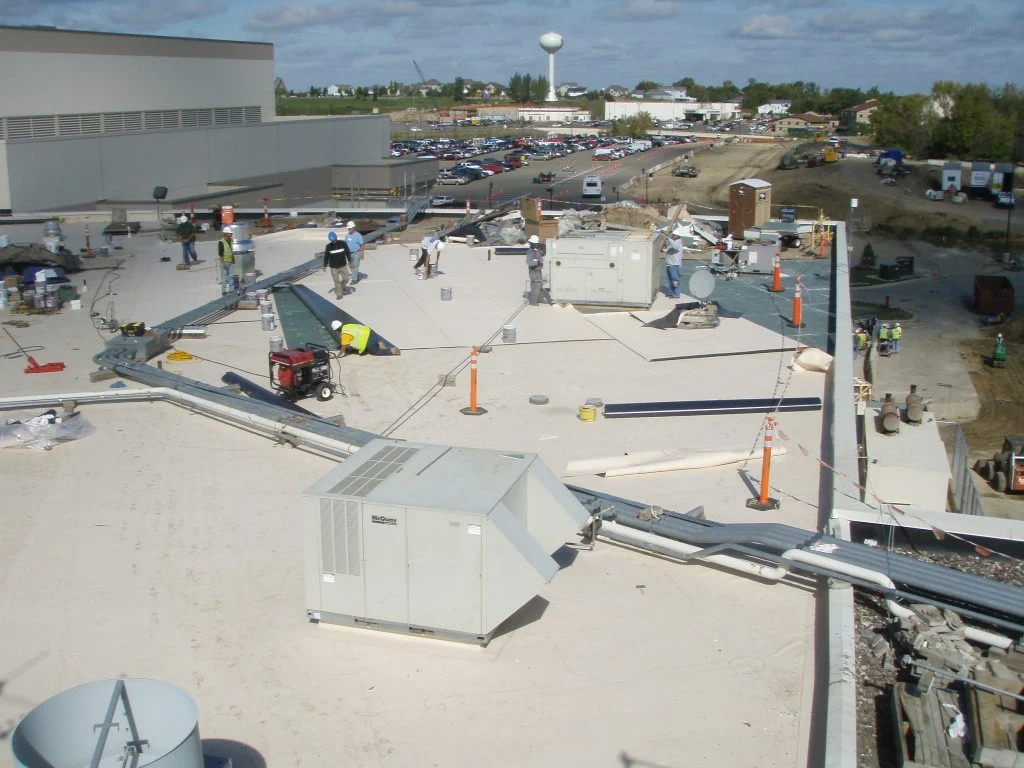
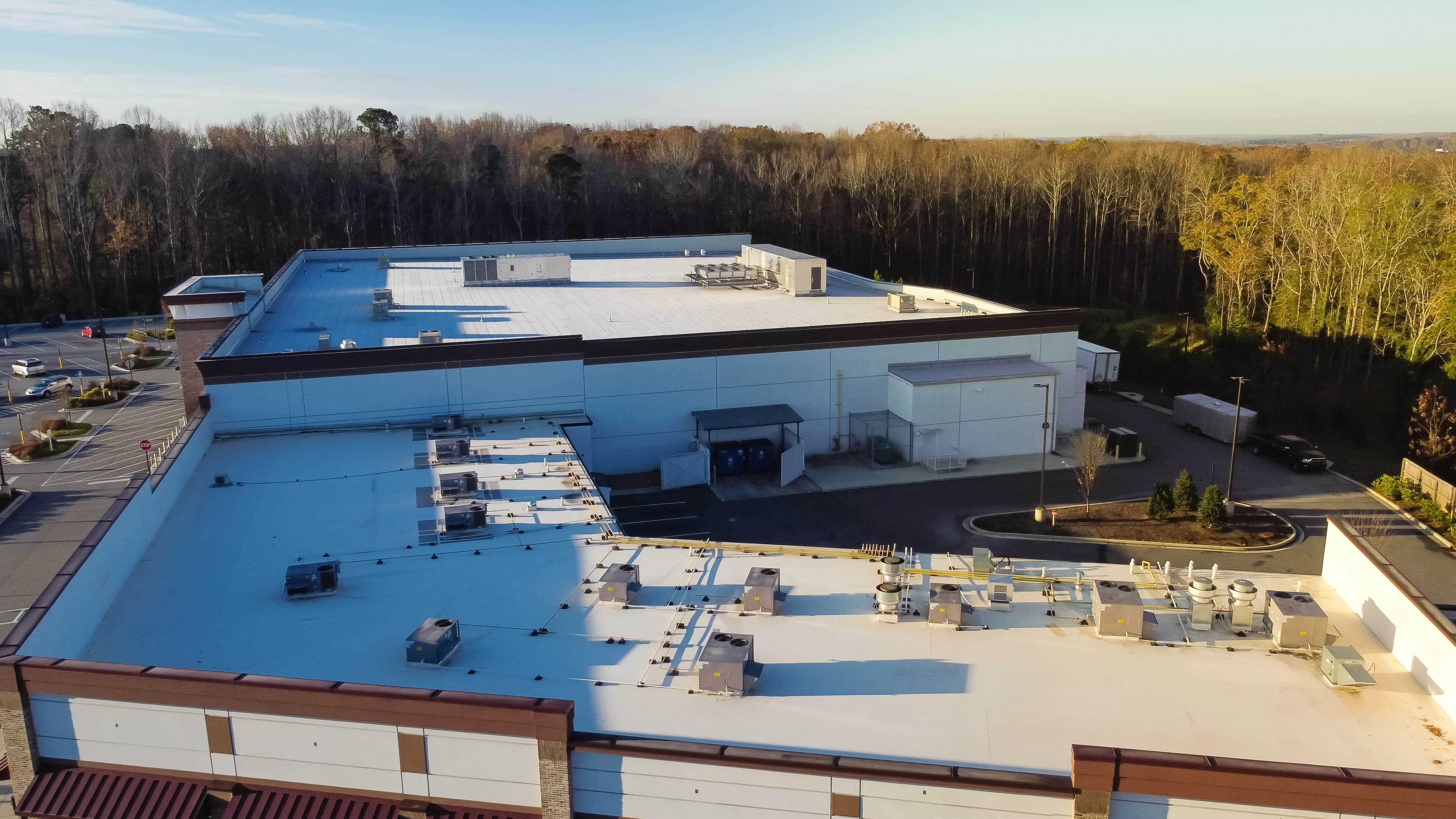
For a building this size, a bank roof is surprisingly busy. Beyond the canopy transition, a typical branch deck carries ATM and night-deposit kiosk enclosures, a rooftop exhaust off the generator transfer-switch room that keeps the branch running through an outage, precision cooling units serving the server and network room, and assorted plumbing and electrical penetrations. Each one is a discrete flashing detail over sensitive space, and each gets documented and detailed individually rather than absorbed into the field. On the small high-visibility roofs banks favor, parapet and edge metal also matter more than usual because the roof line is part of the building's street presentation. Loose or oil-canned edge metal on a branch at a busy intersection is visible to every customer in the drive-through lane, so we hold the edge detailing to a tighter standard than we would on a roof nobody sees.
The small footprint cuts both ways. A branch roof is fast to install, but it leaves almost no margin for error, because the entire deck sits over occupied, sensitive space — there is no back corner over a storage room where a detail can be less than perfect. Every square foot is over a vault, a teller line, a server closet, or a customer lobby. That is why we core and inspect even small bank roofs the same way we would a large one: confirming deck condition, checking for trapped moisture from prior leaks, and verifying insulation before we commit to a recover versus a tear-off.
Security Governs How We Even Get on the Roof
Financial buildings control contractor access more tightly than almost any other property type, and that shapes the schedule as much as the work itself. Contractor badging, escort requirements for any work near vault-adjacent areas, and security-camera documentation of crew activity are standard at bank-owned properties. We build the security-coordination timeline and crew credentialing into the bid up front so it is part of the plan, not a surprise that surfaces as a cost after the contract is signed. We also pull vault-room locations off the building drawings before mobilizing so work on those roof zones is sequenced into approved windows and confirmed with security so no active vault operation is affected by vibration or temporary access changes.
Branch roofing concentrates the loud, disruptive phases — tear-off and installation — into off-hours and weekends, with daily dry-in confirmed before the doors open each morning. We coordinate work windows, noise limits during customer-service hours, and any security escort needs with the branch manager and the corporate facilities team. The customer-facing operation never sees an open roof during business hours.
Single Branches and Whole Portfolios
Financial institutions usually hold more than one building, often under a corporate real-estate structure with centralized facilities management, and the roofing program has to fit that. National and regional bank networks run preferred-vendor programs, standardized scope documentation, and national-account pricing, and we work inside those frameworks for portfolio accounts. We also work directly with the community banks and credit unions managing a single property in the Fort Worth market. Either way, a multi-site owner gets standardized scoping, documentation, and pricing across the portfolio with a single project-management contact for the facilities team.
Common Questions About Bank Roofing
Active tear-off and installation are concentrated into off-hours and weekends, with daily dry-in confirmed before the branch opens each morning. Work windows, noise limits during service hours, and security escort needs are coordinated with the branch manager and corporate facilities.
As an individual flashing item, separate from the field membrane. The canopy-to-building transition is evaluated on its own, and if it is deteriorated, it is re-flashed with a detail built for the differential movement these connections see. It is the most common chronic bank leak and replacing the field membrane alone never fixes it.
Yes. We identify vault locations from the building drawings before mobilizing, sequence work on those zones into approved windows, and confirm with security that no active vault operation is affected by vibration or temporary access changes.
Yes. Portfolio programs — from a regional bank with twenty branches to a national network across Texas — are a regular part of our work, with standardized scoping, documentation, and pricing and a single project-management contact for corporate facilities.