Automotive Manufacturing Roofing
Commercial Property Roofing for Fort Worth buildings: automotive manufacturing roofing is reviewed through roof condition, drainage, flashing, access, warranty status, and budget timing.
Roofs Measured in Acres, Downtime Measured in Dollars Per Hour
An automotive plant is the rare commercial roof where the building owner can tell you exactly what an hour of interrupted production costs, and that number governs everything we do. Fort Worth knows this work well: the General Motors assembly plant in Arlington just to the east anchors a dense regional supply base, and the stamping shops, sequencing centers, and Tier 1 and Tier 2 supplier plants spread through the Alliance and I-820 industrial corridors feed it on tight just-in-time schedules. These buildings run multiple shifts, and a roofing-related stoppage carries a defined cost the plant's facility engineering group hands us before the contract is signed. We plan, mobilize, and execute against that figure, not around it.
Phasing a Million-Square-Foot Deck
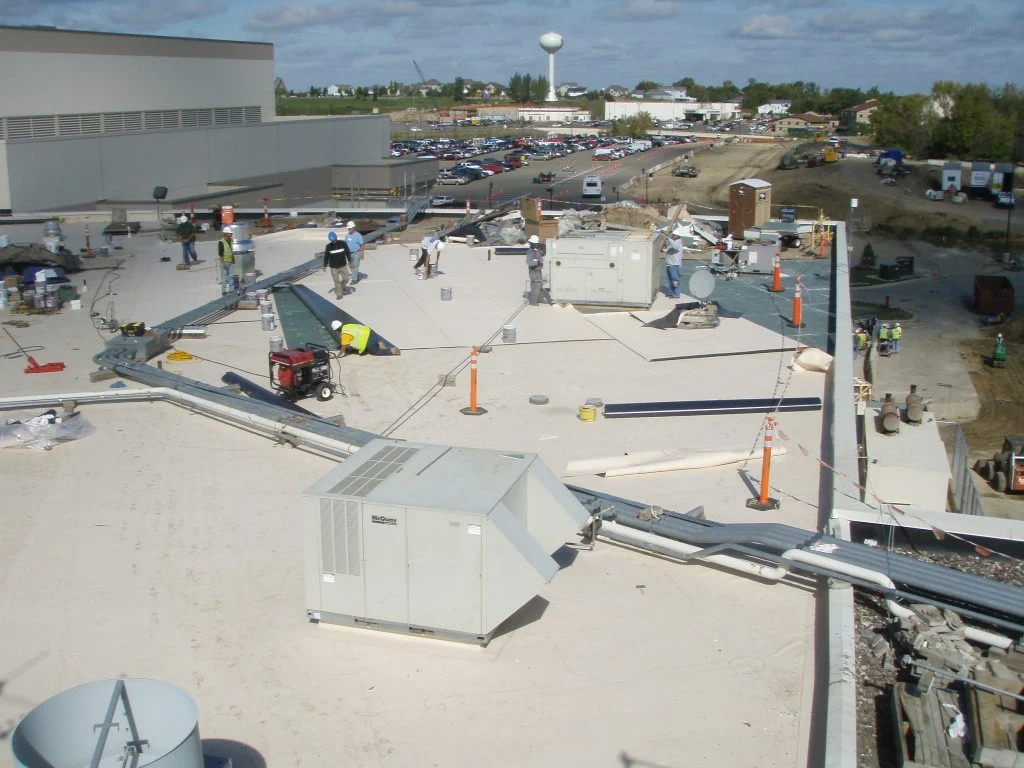
Assembly and powertrain plants carry some of the largest single-envelope roof decks in commercial construction, often well into seven figures of square footage. You do not reroof that in one pass. We section the roof into zones, sequence tear-off and material delivery to stay inside crane reach and on-roof storage limits, and keep production running in adjacent zones while work proceeds in the active phase. The logistics of staging materials, protecting the deck, and moving the crew zone to zone are what separate a clean automotive reroof from one that stops the line, and that planning happens before mobilization rather than on the fly.
The Paint Shop Changes the Rules
Paint operations generate solvent vapor and carry fire-suppression requirements that reach up onto the roof. Over and around paint-adjacent zones, hot work is restricted, which means torch-applied systems and solvent-based adhesives are off the table. We build the hot-work permit plan with the plant's environmental health and safety team during pre-construction and specify cold adhesive or mechanical attachment in those zones so the membrane goes down without an open flame. These are not surprises uncovered at install; they are standard scope items for a paint-shop roof.
Press Vibration and Seam Fatigue
Stamping, casting, and powertrain buildings put energy into the roof that an office or warehouse never sees. Large presses and heavy machining transmit vibration up to the deck at frequencies that can fatigue a poorly welded or adhesive-bonded seam over time.
- Seams rated for the environment: over press-adjacent zones we tighten welding procedures and seam design so the membrane holds against sustained vibration, not just wind and thermal movement.
- Deck capacity confirmed: on facilities with structural load limits we verify what the deck can carry before specifying insulation thickness or new equipment curbs.
- Drainage corrected where it fails: tapered insulation goes into zones with documented ponding rather than as a blanket assumption.
Welding Smoke, Process Heat, and Rooftop Ventilation
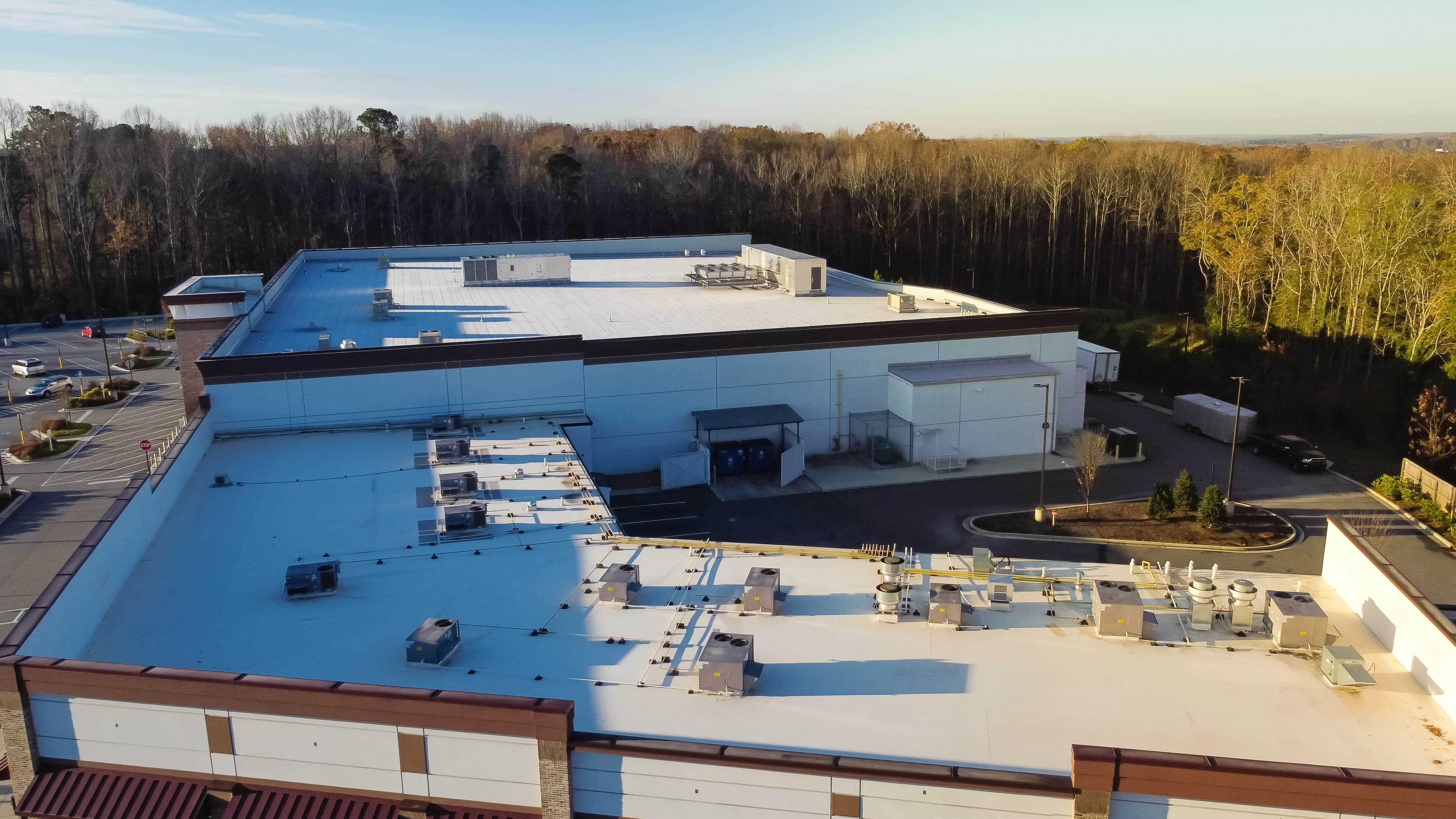
Body shops and weld lines push enormous volumes of smoke and heat up through rooftop ventilation, and the equipment doing that work is heavy, hot, and constantly running. The exhaust hoods, make-up air units, and roof ventilators over a weld or casting area sit on large curbs that take both thermal load and the grime of metalworking, and we detail those curbs to hold up to the heat and the maintenance traffic they see. Skylights and smoke-and-heat vents required for life safety add another layer of penetrations across these vast roofs, and on a reroof we re-flash or replace the aging ones rather than laying new membrane around a tired curb that will leak by the next summer.
Storm Exposure on an Acre of Flat Roof
North Texas takes hard wind and hail, and an automotive plant presents one of the largest uninterrupted targets in the region. The same wind that a small roof shrugs off generates serious uplift across a wide-open deck, and a hail event over a million square feet is a major insurable loss. We size the attachment and the perimeter and corner enhancement for the real exposure, specify membrane thickness with impact resistance in mind, and document the roof's pre-storm condition so a damage claim after a North Texas hailstorm is backed by a baseline rather than a guess. Drainage gets the same scrutiny: on a deck this size, a few blocked drains turn a routine storm into a structural load problem in a hurry.
One Maintenance Foreman, Daily Dry-In, Documentation to Spec
Production continuity is the governing constraint, so we work the plant's shift schedule the way the plant does. We document which zones sit over active lines, phase the work to stay clear of them, confirm a watertight dry-in before each shift change, and keep one direct line open to the maintenance foreman through the whole project. Closeout matches what OEM and supplier facilities expect: safety qualification records, a site-specific safety plan, the OSHA 300 log summary, warranty registration, a roof-zone diagram with a penetration inventory, daily work reports, permit records, and a photographic condition survey, formatted to the plant engineering department's standard. Tier 1 and Tier 2 suppliers get the same discipline, often with even less tolerance for a stoppage because of just-in-time delivery. For plants that want to get ahead of trouble rather than react to it, we also set up a roof asset management program that inventories every zone, tracks the remaining service life of each section, and schedules repairs into planned downtime, so capital roofing spend is budgeted and timed around the production calendar instead of forced by a failure mid-shift.
We map which zones sit over active production, phase the work to stay clear of them, and confirm dry-in before every shift change while keeping direct contact with your maintenance foreman.
With an EHS-approved hot-work plan built in pre-construction and cold-adhesive or mechanically attached systems in the torch-excluded zones, so no open flame goes over paint operations.
Most often 60- or 80-mil TPO mechanically attached, with fully adhered assemblies in paint zones where fastener patterns conflict with hot-work rules, and tapered insulation where drainage is documented as deficient.
Yes. We treat supplier facilities like OEM plants: document the production schedule, sequence around it, and hold daily communication, with extra attention to the zero-slack just-in-time windows.