Medical Building Roofing
Commercial Property Roofing for Fort Worth buildings: medical building roofing is reviewed through roof condition, drainage, flashing, access, warranty status, and budget timing.
Roofing on occupied hospital and medical office buildings requires infection control protocols, HVAC coordination, and logistics planning that most commercial roofers do not have in place. We do.
Fort Worth has four major hospital systems doing active construction and renovation: Cook Children's Medical Center in the Medical District, Baylor Scott & White All Saints Medical Center on Pennsylvania Avenue, JPS Health Network (the county hospital) on 8th Avenue, and Texas Health Harris Methodist on Pennsylvania. Each of those campus roofs involves occupied patient areas directly below the work zone, which changes everything about how the project gets planned.
The primary concern is infection control. Construction debris, including roofing tear-off material, generates particulate that hospital infection control officers take seriously. Aspergillus and other airborne pathogens in demolition dust are a documented infection risk for immunocompromised patients. On Cook Children's work — where the patient population is entirely pediatric, including oncology and transplant patients — the infection control coordinator is part of our pre-construction meeting, not an afterthought.
The secondary concern is HVAC. Hospital HVAC systems run at positive pressure in certain areas and negative pressure in isolation rooms. Rooftop penetrations for hospital mechanical systems are more numerous and more sensitive than on a standard commercial building. Every curb-mounted unit, every exhaust fan, every intake plenum that sits on the roof has to be re-flashed correctly and left in exactly the right operational state at the end of each work day.
Infection Control Protocol on Occupied Medical Buildings
Our pre-construction process on any hospital or medical office building includes an ICRA (Infection Control Risk Assessment) meeting with the facility's infection control officer. That meeting establishes the debris containment requirements, the negative-air requirements if work is happening above a critical care area, and the daily cleaning protocol. We document the agreed protocol and work to it — the infection control officer has our project manager's direct number and can call a work stoppage if we are not in compliance.
Tear-off debris from rooftop work above occupied patient areas goes into sealed containers — not open dumpsters — before it leaves the roof. On Cook Children's work, where the facility is LEED-certified and has specific waste handling requirements, we coordinate the debris disposal method with the facility's sustainability office. This is a different process than a warehouse reroof, and our team knows the difference.
Penetrations in the roof deck above occupied areas are covered and sealed at end of every shift. We do not leave open holes in a hospital roof overnight, and we do not leave open holes during a weather hold. The temporary dry-in protocol on medical buildings is more conservative than on any other property type we work on.
HVAC and Rooftop Equipment Coordination
JPS Health Network's hospital at 8th Avenue and Rosedale runs a complex rooftop mechanical plant — chillers, cooling towers, emergency generator exhaust, multiple HVAC air handling units serving different pressure zones inside the building. Re-flashing that equipment during a roof replacement requires coordination with the facilities engineering team, not just the property manager. We schedule a pre-construction facilities walk specifically to photograph and document every rooftop penetration, unit, and curb before we touch anything.
Texas Health Harris Methodist on Pennsylvania has undergone multiple additions and renovations, which means the rooftop is a patchwork of different systems from different eras. We have worked on roofs where two different membrane types were installed in the same roof field by different contractors on different addition projects. That condition requires extra documentation and a clear demarcation plan before tear-off starts.
Managing roofing on a Fort Worth medical building or hospital campus?
Our project managers have run pre-construction ICRA meetings at Fort Worth medical facilities. We will walk the roof with your facilities team, document the infection control requirements, and produce a scope that meets both roofing standards and the facility's patient safety protocols.
Frequently Asked Questions
Do you have experience with hospital infection control requirements?
Yes. We have worked on medical office buildings and hospital ancillary buildings adjacent to Cook Children's, Baylor Scott & White All Saints, and JPS. Our pre-construction process includes an ICRA meeting, a debris containment plan, and a rooftop access protocol that satisfies the facility's infection control officer. We are not learning this process on your building.
Can rooftop work happen above occupied patient rooms?
It can, with the right containment and sequencing plan. The infection control officer and the facilities manager define the constraints — which areas are off-limits for work above, which shifts have the lowest patient census in the relevant rooms, whether negative-air containment is required. We design the sequencing plan around those constraints. In some cases, we sequence the most impactful work for overnight shifts when the patient census in the area below is lowest.
What do you do if an HVAC unit on a hospital roof needs to stay operational during the reroof?
We build a temporary equipment isolation detail around the unit — effectively a temporary curb-flashing assembly that keeps the unit operational and weathertight while we work around it. The unit gets permanently re-flashed in its own phase, which we schedule with the facilities engineering team for a window when the affected HVAC zone can be temporarily taken offline.
How do you handle the permitting for hospital roofing work in Fort Worth?
City of Fort Worth building permits for roofing work on licensed healthcare facilities require coordination with TDH (Texas Department of Health) in some circumstances, particularly for Federally-regulated facilities like JPS (which operates under county hospital district rules). We confirm the permit path during pre-construction — the process is established, just more layered than a standard commercial permit.
Roofing for medical building roofing across Fort Worth
Commercial Roofers Fort Worth specializes in the roof systems that fit medical building roofing — and the operational realities that come with them. These buildings carry specific demands: rooftop mechanical loads, tenant or occupant continuity, code and warranty requirements, and budgets that have to be planned years ahead. We bring commercial-only expertise to every medical building roofing roof in the Fort Worth, TX market, from inspection through replacement.
We work across all major low-slope assemblies — TPO, PVC, and EPDM single-ply, modified bitumen, built-up roofing, metal, and silicone or acrylic restoration coatings — and we match the system to the building rather than to a single product line. For medical building roofing, that means weighing reflectivity and energy cost, foot traffic and equipment access, fire and wind ratings, and how long the owner intends to hold the asset.
- Roof condition assessments and infrared moisture surveys
- Leak diagnosis and permanent repair
- Re-roof and recover scopes engineered for medical building roofing
- Restoration coatings to defer capital replacement
- Preventive maintenance programs with documented inspections
- Storm, hail, and wind damage documentation for claims
Protecting operations during the work
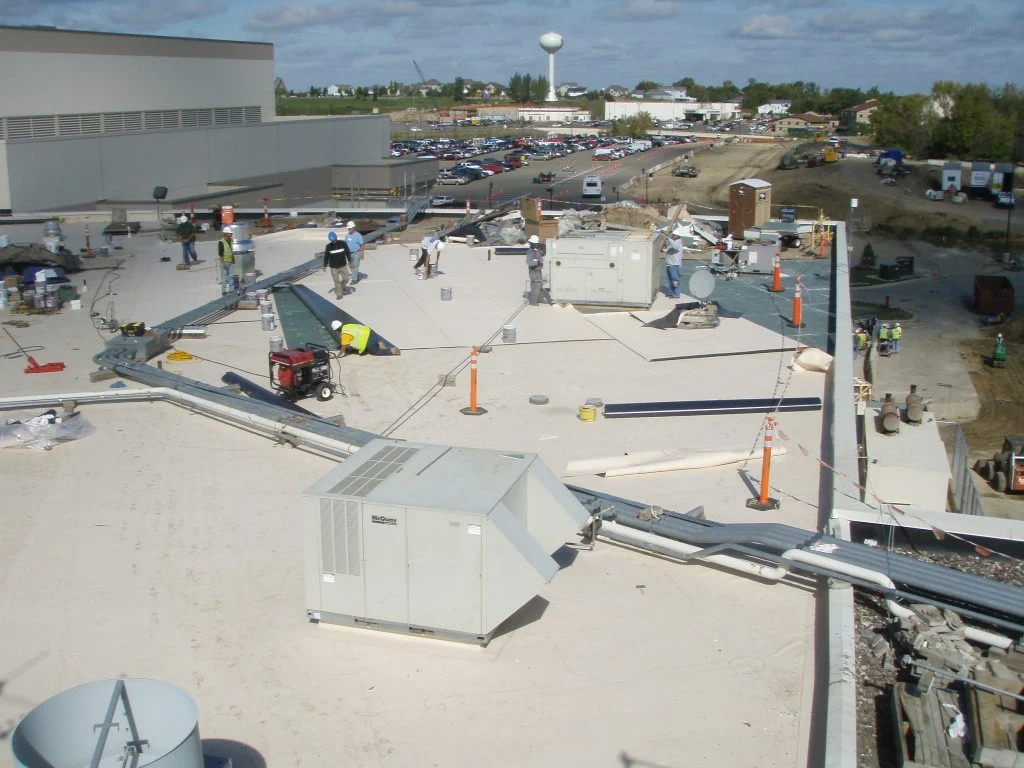
The hardest part of roofing medical building roofing is rarely the roof itself — it is doing the work without disrupting what happens below. We sequence projects around occupancy, coordinate with facility staff on access and noise windows, and protect rooftop equipment, intakes, and interiors throughout. Occupied buildings stay open; sensitive operations stay protected.
Every project is backed by documentation: pre-construction photos, daily progress notes, and closeout records including warranty registration and a forward maintenance plan. For owners and managers responsible for medical building roofing, that paper trail is what turns a roof from an unpredictable expense into a planned, manageable asset.
Planning the roof as an asset
Most medical building roofing owners do not want to think about the roof until it leaks — and by then the cheap fixes are gone. We help you get ahead of that with condition reporting, remaining-service-life estimates, and budget forecasts so a replacement is a scheduled line item, not an emergency. Where a roof still has life, a restoration coating can add years for a fraction of replacement cost.
Call Commercial Roofers Fort Worth to schedule an assessment of your medical building roofing roof in Fort Worth. You will get a written scope, clear options, and honest guidance on whether to repair, restore, or replace.
Frequently Asked Questions
How quickly can Commercial Roofers Fort Worth respond to a leak?
For active leaks and water intrusion we prioritize same-day or next-day response across Fort Worth and the surrounding metro. We tarp or make a temporary dry-in immediately to stop interior damage, then schedule the permanent repair once the roof is dry and the source is confirmed. Emergency response is available 24/7, and existing maintenance clients move to the front of the queue.
Do you repair commercial roofs or only replace them?
Both — and we recommend the option the roof actually justifies. Many roofs have years of service life left and only need targeted repairs, flashing work, or a restoration coating. Replacement is recommended only when the membrane is failing, the insulation is saturated, or the cost of ongoing repairs no longer makes sense. You receive a written scope with the reasoning either way.
What roof systems do you install?
We install and service all major low-slope commercial assemblies: TPO, PVC, and EPDM single-ply membranes, modified bitumen, built-up roofing, standing-seam and other metal systems, and silicone or acrylic restoration coatings. We match the system to the building's use, budget, and ownership horizon rather than pushing a single product.
Will the work disrupt our building operations?
We plan around your operations. Projects are sequenced section by section on occupied buildings, access and noise windows are coordinated with facility staff, and rooftop equipment and interiors are protected throughout. Most medical building roofing in Fort Worth is completed with minimal disruption to tenants and daily activity.
What documentation do we receive?
Every project includes a documented roof condition assessment up front and a full closeout package at the end: photos, an itemized scope, warranty registration, and a recommended maintenance schedule. That record keeps manufacturer warranties valid and makes future budgeting and capital planning far easier.