Food Processing Roofing
Commercial Property Roofing for Fort Worth buildings: food processing roofing is reviewed through roof condition, drainage, flashing, access, warranty status, and budget timing.
Two Climates in One Building, Both Hard on a Roof
A food plant fights its roof from two directions at once. Down on the production floor, daily high-pressure washdown drives warm, humid air up against the deck, while a few bays over a blast freezer or chill room pulls the assembly cold enough to sweat from the inside. Fort Worth's food and beverage base, anchored by the long-standing distribution and processing operations out along the Meacham and the Alliance freight corridors and the cold-storage and protein plants feeding the regional grocery chains, runs exactly this mix of hot washdown and deep refrigeration under one membrane. We build food-plant roofs to handle both, because getting one right and the other wrong still rots the deck.
A leak over a running line here is not a maintenance call. It is a potential food-safety event that pulls in the plant's quality team, can trigger a product hold, and generates regulatory paperwork. We scope this work to keep that from happening rather than to clean up after it.
Materials the Plant's Food-Safety Plan Will Accept
Membrane selection on a food plant starts with the acceptability list for the specific production environment, not with whatever sits cheapest on the truck. Not every commercial membrane is approved for use above a food-contact zone. White TPO and PVC single-ply are generally acceptable over enclosed processing areas, but we confirm the exact product and installation method against the facility's food-safety plan first. The adhesives, primers, and sealants in the flashing details get the same scrutiny, because many standard roofing adhesives carry solvents a food environment will not permit.
Washdown Humidity and the Vapor Drive
Sanitation washdown loads the production space with warm moisture that wants to migrate straight up into the roof assembly. If the vapor retarder is in the wrong place for Fort Worth's climate, that moisture condenses inside the build-up, soaks the insulation, and corrodes the deck with no exterior leak to warn anyone. We confirm the vapor-retarder strategy and the existing assembly's moisture condition before we recommend a recover or a tear-off, and a moisture survey is standard on a washdown facility rather than optional.
Refrigeration Loads and Cold-Chain Continuity
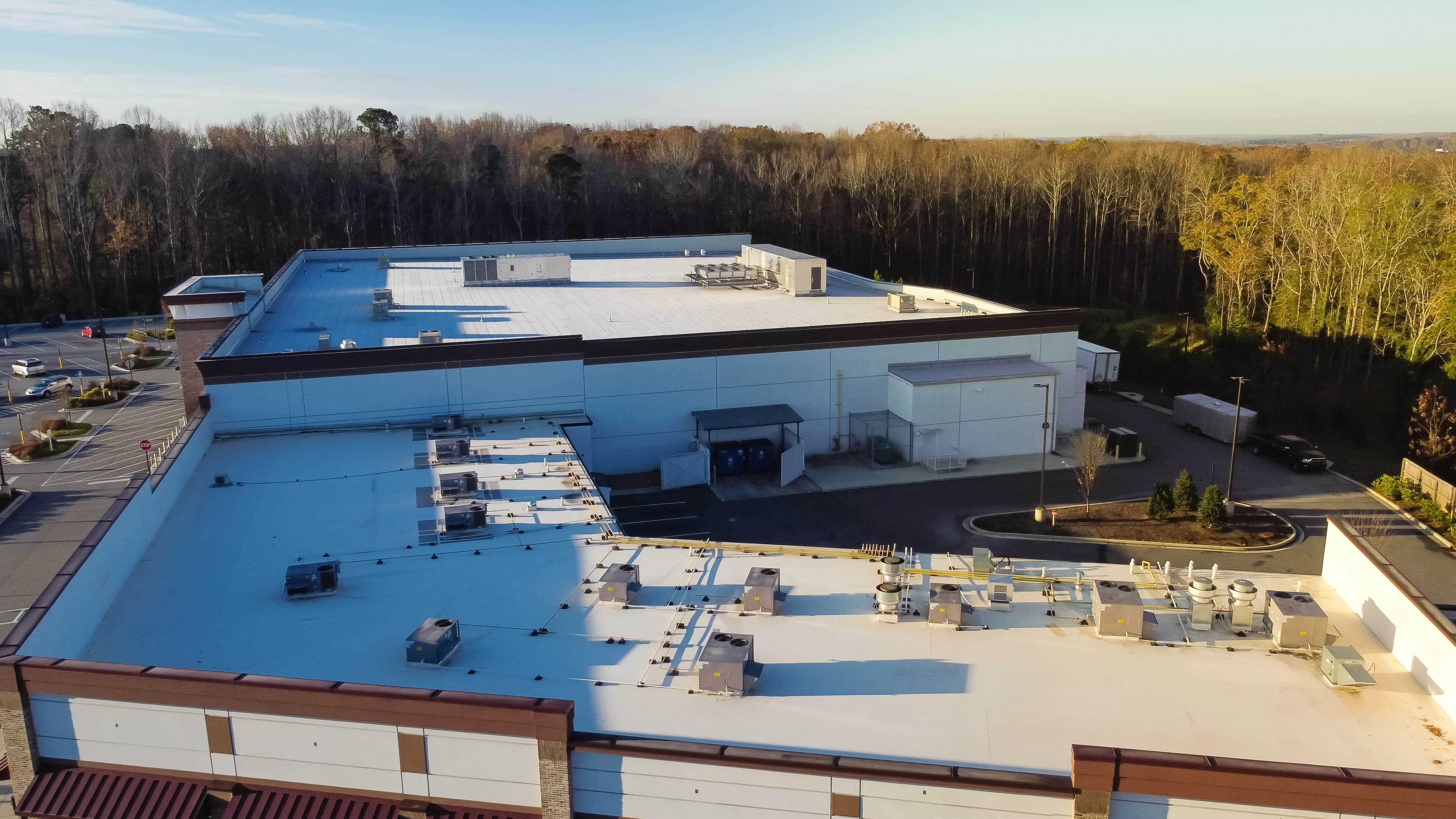
The roof over a freezer or chill room carries weight and thermal duty most low-slope roofs never see. Heavy rooftop refrigeration units and condensers add concentrated point loads we verify against the deck capacity, and the insulation has to maintain thermal continuity so the cold chain holds without the assembly sweating.
- Tapered insulation tuned to the freezer: drainage above a cold room is designed around the operating temperature and the vapor-drive direction, because ponding over a freezer adds refrigeration load and feeds deck corrosion.
- Equipment loads verified: we confirm the deck can carry the refrigeration package before we add insulation thickness or new curbs.
- Penetrations sealed for the cold side: refrigerant lines and condensate runs are flashed to hold against condensation, not just rain.
Rooftop Equipment, Sanitation Chemicals, and Membrane Wear
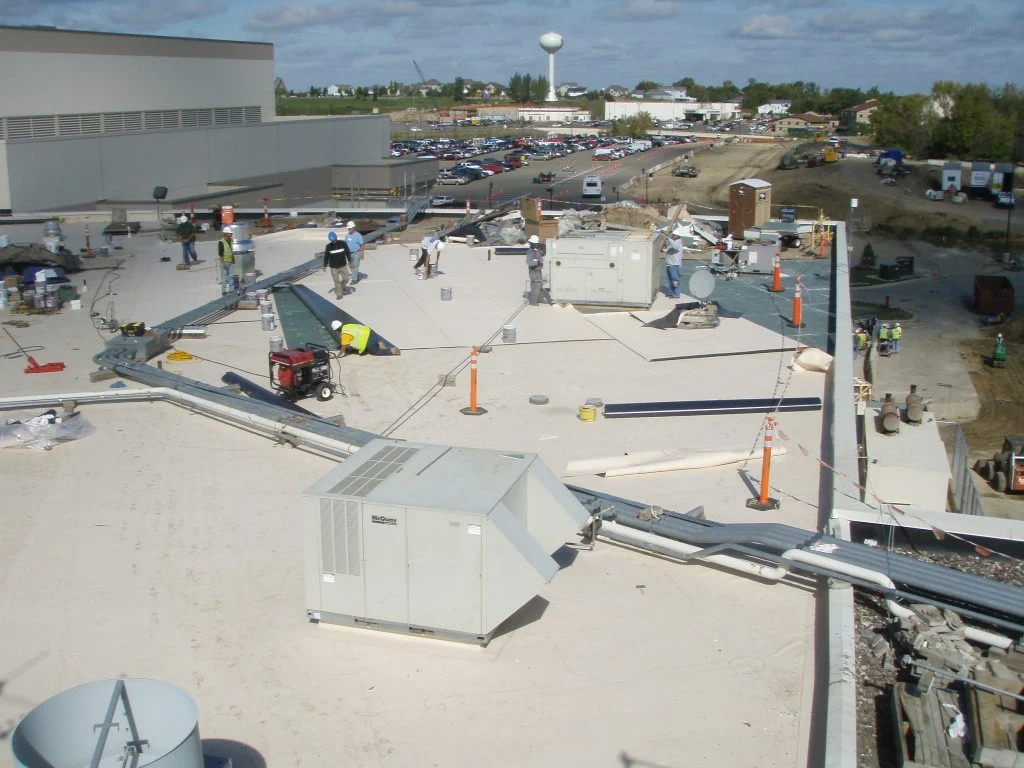
A processing roof carries more than refrigeration. Make-up air units, exhaust fans over cookers and fryers, condensate lines, and process piping crowd the deck, and each one is a penetration that has to be detailed and a point where wear concentrates. Grease-laden exhaust over a cook line degrades a membrane the way it degrades a restaurant roof, so we keep grease containment at those fans and choose membrane and walkway protection that tolerates the foot traffic of a maintenance team servicing equipment weekly. The sanitation chemistry itself matters too: aggressive caustic and acid washdown compounds can carry into rooftop drains and onto the membrane near interior drain leaders, and we account for that exposure where it exists rather than assuming a generic roof will shrug it off.
Inspections That Keep You Audit-Ready
Roof condition is a standard line item in USDA and FDA facility inspections, where an inspector looks for leaks, condensation, and deterioration that could put moisture over a production area. A plant that can produce a current condition report and a record of repairs is in a far stronger position than one explaining a stain. We run scheduled inspections that document the membrane, the seams, the underside of the deck over both the washdown floor and the refrigerated bays, and the penetration field, and we deliver a written report the QA manager can hand an inspector. Catching wet insulation or a failing seam on a planned visit also keeps the fix inside a sanitation window instead of forcing an emergency intrusion over a running line.
Sequencing Around the Sanitation Window
Most Fort Worth food plants run two or three shifts with one weekly sanitation window as the only time the floor is down. Any work that opens the envelope over an active line is confined to that window, with the production team and the QA manager confirming the floor is clean and protected before we start. We phase the project around the plant's schedule, and we keep an emergency line open: a leak over a running line gets an after-hours response, a priority dry-in, and the documentation the plant needs for its own incident reporting.
No. USDA- and FDA-regulated areas require the membrane, adhesives, primers, and sealants to be confirmed acceptable for the production environment first. We verify each product with your QA team before specifying anything over a food-contact zone.
By tuning the insulation and vapor control to the actual operating temperature and drainage so the assembly stays above the dew point on the cold side, and by confirming drainage carries water off the freezer bay instead of ponding on it.
Over active lines, during your weekly sanitation window or a planned shutdown. Work over non-production areas can run on a normal schedule, and we coordinate any refrigeration-adjacent work with your maintenance team.
You call our emergency line, we mobilize for a priority temporary dry-in, and we supply the condition and repair documentation your QA team needs for the hold evaluation and incident record.