Roof Drain Cleaning & Repair
Commercial Roofing Services for Fort Worth buildings: roof drain cleaning & repair is reviewed through roof condition, drainage, flashing, access, warranty status, and budget timing.
A blocked or failed drain turns a Fort Worth summer thunderstorm into a structural ponding event. We clean, repair, and replace internal drains and scuppers — and we address the underlying slope and drain-placement issues that create chronic ponding problems.
Fort Worth receives approximately 35 inches of annual precipitation, but the distribution is heavily front-loaded into intense convective storm events. The city can receive an inch of rain in twenty minutes during a summer thunderstorm — which is a hydraulic load that overwhelms a partially-blocked drain system as completely as a full blockage. Roof drains on Fort Worth commercial buildings are not a passive maintenance item; they are a primary structural load-management component.
Ponding water on a commercial flat roof creates four distinct problems: structural load (water weighs 5.2 pounds per square foot per inch of depth, and roofs are designed for two to four inches of ponding tolerance in most standard loading calculations), membrane degradation (extended water contact accelerates oxidation in EPDM, attacks seam adhesives, and creates freeze-thaw stress at standing-water edges in winter), insulation saturation (once insulation wets, it does not dry out and requires replacement), and building interior infiltration risk (any drain-adjacent membrane failure is adjacent to a concentrated water source).
We service internal drains, overflow drains, primary scuppers, and emergency overflow scuppers. Our drain service ranges from seasonal debris-clearing to drain bowl replacement, clamping ring reseal, interior leader pipe repair, and drain relocation for buildings where the original drain placement produced chronic ponding that routine cleaning cannot resolve.
Internal Drain Inspection and Replacement
Internal roof drains on Fort Worth commercial buildings are cast-iron or PVC drain bodies with a clamping ring that compresses the roof membrane against the drain flange, a strainer or dome to prevent debris entry, and a leader pipe connection to the interior storm drain system. Failure modes include: clamping ring corrosion (iron drain bodies in the humid Tarrant County summers corrode faster than in dry climates), membrane separation at the drain nailer (the membrane pulls away from the drain flange under thermal movement), and leader pipe connection failures inside the roof deck assembly.
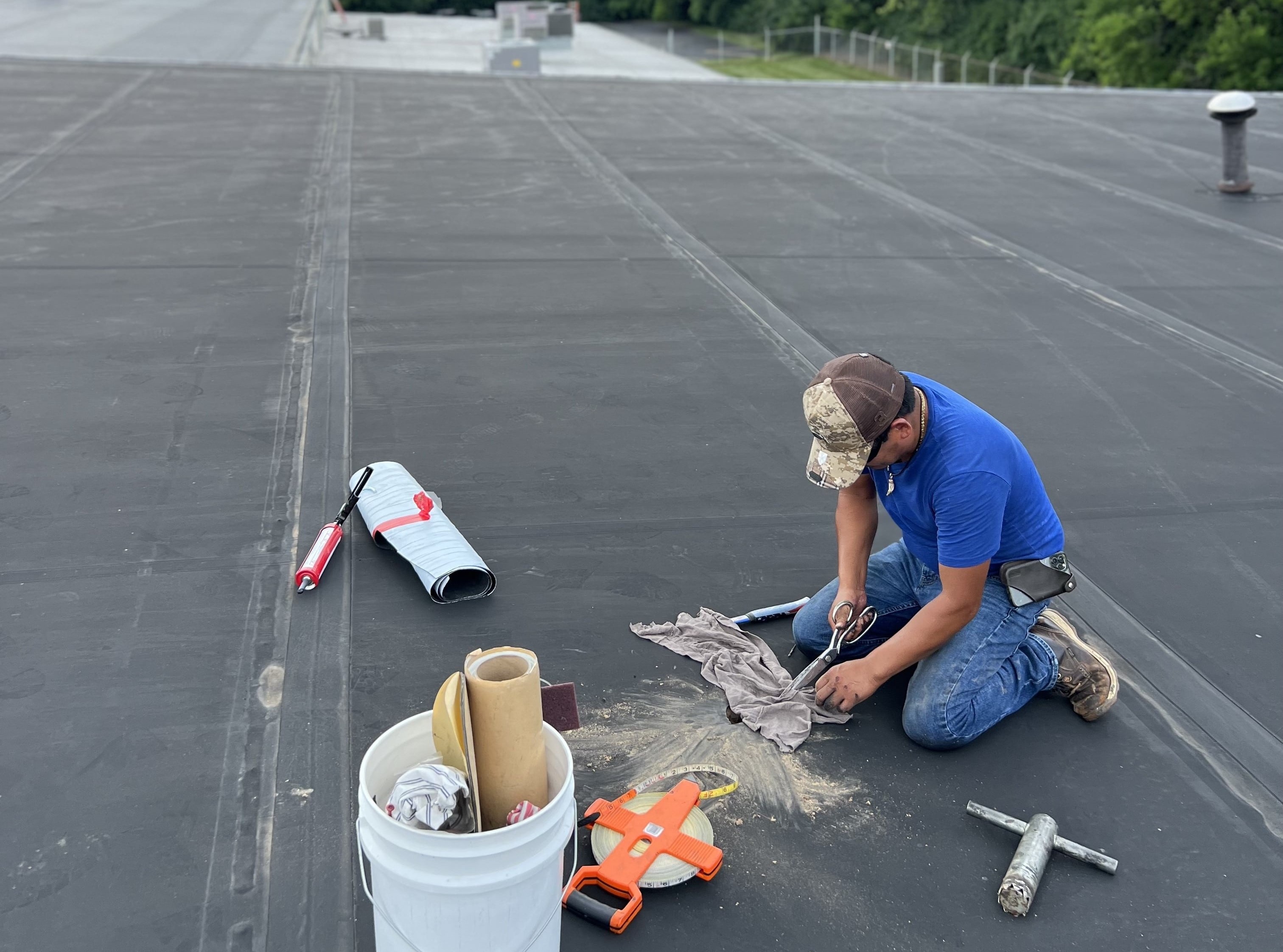
Drain replacement on a built-up or modified-bitumen roof requires removing the membrane layers around the drain, installing the new drain body at the correct elevation, and integrating the new drain into the existing membrane with an appropriately sloped membrane collar. On TPO and EPDM systems, the drain integration includes a bonded membrane sump at the drain edge. We match the drain material to the existing system — iron, cast-iron, PVC, or stainless — and specify the drain body rating for the structural loading the Fort Worth code requires.
Fort Worth's Blackland Prairie clay soil movement — which is significant across eastern Tarrant County — can cause drain bodies to shift slightly over years of seasonal expansion and contraction. A drain that has shifted out of plumb creates a gap at the clamping ring that no amount of cleaning will fix. We probe the drain-to-membrane interface at every inspection and flag any separation for immediate repair — a gap at the drain is a guaranteed leak path the next time rain loads that section of roof.
Scupper Repair and Replacement
Scuppers are through-wall openings at the base of a parapet wall that allow surface water to drain over the wall edge rather than through an internal drain. They are common on Fort Worth commercial buildings where the interior drain plumbing was not planned for in the original construction, and as overflow drains on buildings with internal drain primary systems — the code requires overflow protection at a maximum ponding depth of two inches for most commercial roof assemblies.
Scupper failures occur at three points: the scupper sleeve-to-wall interface (typically a lead or EPDM boot that deteriorates under UV and freeze-thaw cycling), the membrane transition at the scupper opening (where the roof membrane has to make a right-angle turn down into the scupper throat), and the exterior scupper face where the discharge end may be blocked by debris, bird nests, or deteriorated exterior cladding. We address all three in a scupper repair scope — a scupper that drains well at the interior but discharges against a blocked exterior face is a ponding-risk.
Scupper sizing for Fort Worth's storm-intensity profile: Fort Worth's design rainfall intensity for a 100-year storm is approximately 8–9 inches per hour for a 15-minute duration. That intensity drives scupper sizing calculations significantly — an undersized scupper system that was adequate for normal rainfall becomes an overflow risk during a major convective event. If we identify undersized scuppers during a drain inspection, we flag it and provide the sizing calculation so the owner understands the storm-frequency risk.
Ponding Correction — When Cleaning Is Not Enough
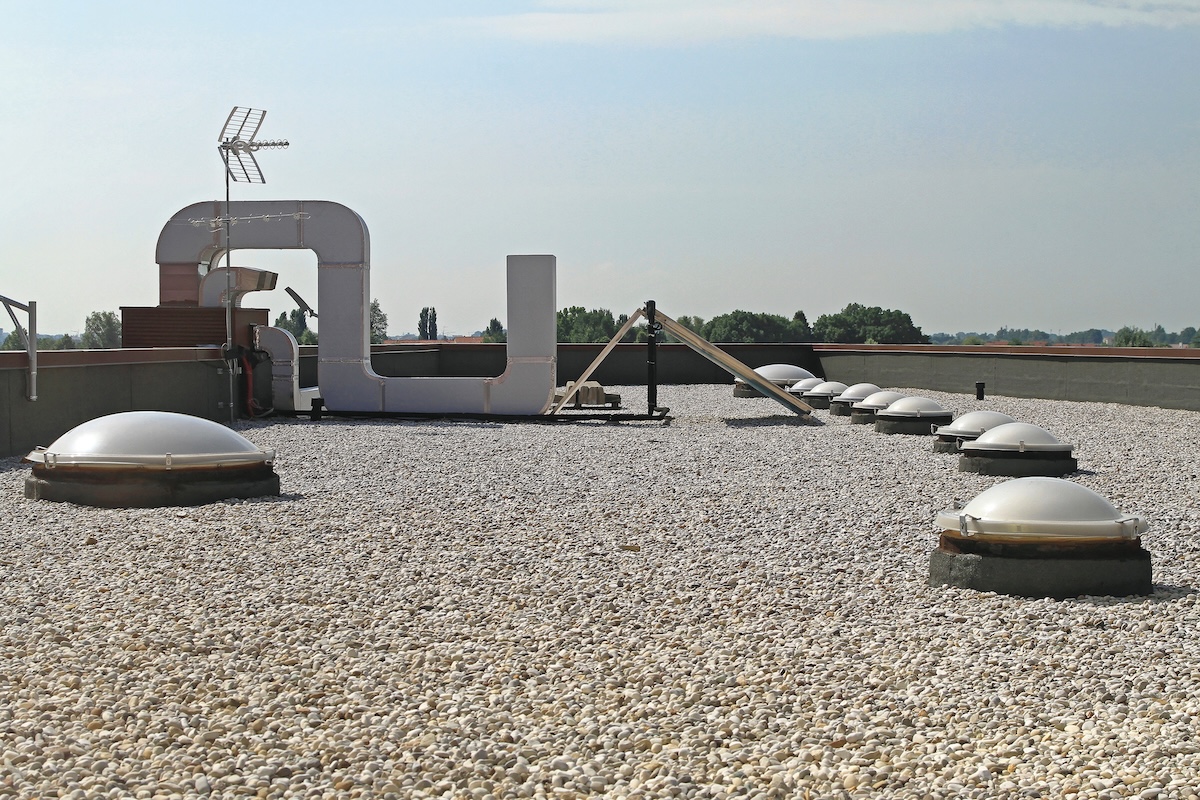
Some Fort Worth commercial roofs pond chronically not because the drains are blocked but because the roof was installed without adequate slope, the tapered insulation package was not specified correctly, or the original drain placement does not match the low-point geography of the roof surface. Cleaning the drains on a flat-flat roof (no slope, no tapered insulation) produces clean drains that still pond — because there is no slope to move the water toward them.
Ponding correction on an existing commercial roof is a design-and-execution problem. The options are: tapered insulation overlay (add a tapered polyiso system over the existing insulation to create positive slope toward the drains), drain relocation (move drains to the actual low points, which requires interior plumbing coordination), or a combination of both. We survey the roof surface elevation profile with a laser level before designing a ponding correction scope so we know which approach is feasible for the building's structural and plumbing configuration.
Fort Worth's IBC 2021 adoption requires that reroofed commercial buildings meet current drainage standards — meaning a replacement scope on a building with existing chronic ponding must address the drainage design, not just replace the membrane over the same flat surface. We account for this in replacement scopes so owners are not surprised by the tapered insulation add-cost during the project.
Roof drains blocked, leaking, or chronically ponding on your Fort Worth building?
We inspect, clean, repair, or replace — and we tell you honestly whether the drain problem is the drain itself or a drainage design issue that cleaning alone will not fix.
Frequently Asked Questions
How often should Fort Worth commercial roof drains be cleaned?
Semi-annually is the standard for most Fort Worth commercial buildings — once in spring (after cottonwood and oak pollen season, which produces significant organic debris accumulation in Fort Worth from March through May) and once in fall (after deciduous leaf fall). Buildings surrounded by mature trees or in areas with heavy bird activity may need quarterly cleaning. We include drain inspection and clearing in all of our semi-annual maintenance inspection visits.
How do I know if my roof has overflow drain protection?
Your original construction documents should specify overflow drain locations and elevations. If you do not have those documents, we can identify overflow drains (or the absence of them) during a roof inspection. Code-required overflow protection is a life-safety issue — a roof without overflow drains that ponds deeply enough to exceed the structural live-load capacity can experience partial collapse. We flag missing overflow protection in every inspection report.
My drain is leaking around the clamping ring, not blockage. Is that a drain issue or a roofing issue?
Both, and the repair covers both. A leaking clamping ring means the membrane-to-drain interface has failed — the repair involves pulling the clamping ring, cleaning the drain flange, resetting the membrane, and re-torquing the clamping ring to manufacturer specification. On older iron drains where the flange surface is corroded and cannot seal properly, drain body replacement is the permanent repair. We scope it as a roofing repair because it is a membrane integration problem.