Modified Bitumen Roof Systems
Commercial Roof Systems for Fort Worth buildings: modified bitumen roof systems is reviewed through roof condition, drainage, flashing, access, warranty status, and budget timing.
Modified bitumen is the dominant system on Fort Worth's downtown legacy commercial stock and older Tarrant County neighborhood retail. We install new mod-bit, recover over existing systems, and make the replace-versus-recover call on aging installations.
Modified bitumen roofing — asphalt modified with APP (atactic polypropylene) or SBS (styrene-butadiene-styrene) polymer — has been the standard specification for Fort Worth commercial buildings in the 10,000-50,000 square foot range since the late 1980s. The downtown core between West 7th and I-30, the Camp Bowie West retail corridor, and the older neighborhood commercial strips throughout Fort Worth's urban neighborhoods carry large volumes of modified bitumen roofs installed between 1988 and 2010.
A well-installed modified bitumen system performs 20-25 years in Fort Worth conditions. A lot of what we inspect has not been well-maintained — blistering at seams, lap delamination, granule loss on the cap sheet, failed drains, open pipe penetrations. These are manageable problems on a system with 5-10 years of life remaining, but they accelerate to water intrusion quickly in Fort Worth's summer storm season.
The recover-versus-replace decision on mod-bit is the same as for any system: cores first. If the insulation is dry, a new single-ply recover extends the asset at lower cost than full replacement. If the insulation is wet, replacement is the honest answer. We've seen too many Fort Worth buildings get a new cap sheet applied over saturated insulation — the new sheet looks fine until the trapped moisture destroys the deck from underneath.
Torch-Down vs. Self-Adhered Modified Bitumen
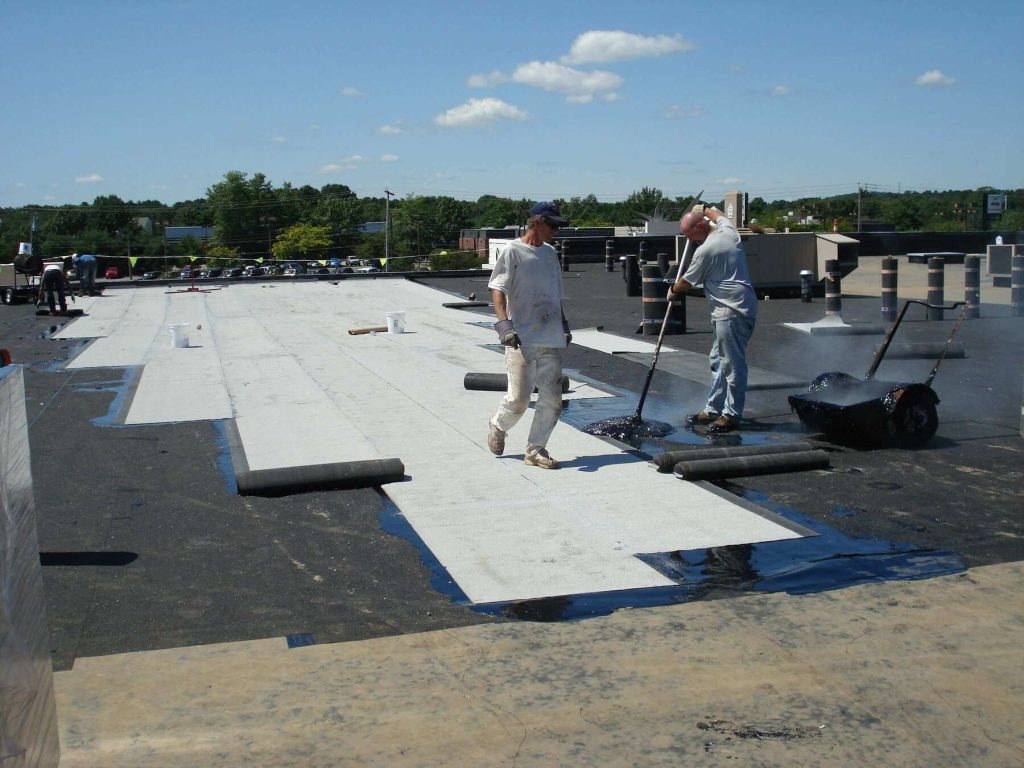
Torch-applied modified bitumen — typically SBS polymer modified — is installed by open-flame propane torch. The heat activates the bitumen on the underside of the sheet, bonding it to the substrate. Torch-down produces the highest-quality bond in modified bitumen installation when done correctly. It requires certified operators and fire-watch protocols, particularly on Fort Worth buildings with roof decks over occupied space. City of Fort Worth fire watch requirements for torch-applied work apply — we follow them without exception.
Self-adhered modified bitumen uses factory-applied adhesive on the underside of the sheet — peel-and-stick installation without open flame. It is specified on buildings where torch application is prohibited or operationally impractical (occupied buildings, sensitive tenant environments, occupied-space roof decks where any smoke odor is a tenant issue). Self-adhered systems carry comparable performance and warranty to torch-applied when installed in the right temperature range — above 40°F for adhesive activation. Fort Worth's winters rarely prevent self-adhered installation.
APP-modified bitumen is the dominant cap sheet specification in the Fort Worth market — more UV-stable than SBS in the Texas heat, granule-surfaced, and compatible with torch and self-adhered application. SBS-modified base sheets are used in multi-ply assemblies for their superior low-temperature flexibility (relevant for Fort Worth's Uri-scale freeze events).
Modified Bitumen Recover Decisions on Fort Worth Downtown Stock
The downtown Fort Worth commercial buildings between Throckmorton and Commerce, north of I-30 — older Class B and C office, converted retail, mixed-use buildings — are in active replacement and recover cycles. Many were built in the 1960s-1980s with built-up roofing that was recovered with modified bitumen in the 1990s-2000s. We're now looking at second-generation recover decisions: can the existing mod-bit system support another recover, or does the accumulated roof weight require full tear-off and a fresh start?
The answer is structural. Most commercial buildings are designed for one roof system plus one recover — roughly 8-12 lbs per square foot. Two layers of modified bitumen on top of insulation can approach or exceed this. Before specifying a second recover, we verify the structural capacity with the building's engineer of record or with an independent structural assessment. If the deck can support it, a TPO or PVC recover over the existing mod-bit is often the most economical path. If it cannot, full tear-off is the only safe option.
Modified bitumen roof assessment for a Fort Worth building?
We will walk the roof, pull cores, document the deck condition, and give you a written recover-versus-replace recommendation with cost comparison.
Frequently Asked Questions
What is the difference between APP and SBS modified bitumen?
APP (atactic polypropylene) modifier makes the asphalt more plastic and UV-stable — better for hot climates like Fort Worth's summer. SBS (styrene-butadiene-styrene) modifier makes the asphalt more elastic and flexible — better for cold-temperature performance. Most Fort Worth specifications use APP for the cap sheet (the exposed layer) and SBS for the base sheet when a two-ply assembly is specified.
Can modified bitumen be installed in Fort Worth's summer heat?
Yes. Torch-applied work is not temperature-limited. Self-adhered systems require ambient temperatures above 40°F for adhesive activation, which is not a summer concern. What summer installation does require is early-morning production windows — we do not install mod-bit cap sheets in the 1-5 PM peak heat window in July and August, both for crew safety and to avoid overheating the adhesive.
Our older Fort Worth commercial building has been patched many times. At what point is replacement the right call?
When repair costs in a 3-year window approach 30% of replacement cost, or when moisture cores show more than 25% insulation saturation, or when the deck condition at inspection ports shows corrosion or structural softening — those are the three triggers we use. A building that's been patched 10 times isn't going to be fixed by the 11th patch. We'll tell you clearly when replacement is the right answer.
Do you pull fire-watch for torch-down work in Fort Worth?
Yes. We follow City of Fort Worth fire-watch requirements for torch-applied roofing — a designated fire-watch monitor for the duration of torch operations and for 60 minutes post-completion. Torch-applied work on occupied buildings requires additional coordination with building management and, in some cases, the fire marshal's office. We handle all of this as part of pre-construction.
Modified Bitumen Roof Systems for Fort Worth commercial buildings
Commercial Roofers Fort Worth provides modified bitumen roof systems as part of a commercial-only roofing practice serving Fort Worth, TX and the surrounding metro. We focus exclusively on flat and low-slope commercial roofs — offices, warehouses, retail, schools, medical, and industrial facilities — so the work is scoped by people who do this every day, not as a sideline to residential roofing.
Good modified bitumen roof systems starts with knowing the roof. Before we recommend anything we document the existing assembly, its age and condition, drainage and flashing details, and any active or hidden moisture. That assessment drives a written scope so building owners and managers understand the problem, the options, and the cost before committing.
- Documented roof condition assessment up front
- Clear, itemized written scope of work
- Manufacturer-approved materials and installation details
- Coordination around occupancy and rooftop equipment
- Photo documentation and warranty paperwork at closeout
- A maintenance plan to protect the investment afterward
What to expect from the process
Once a scope for modified bitumen roof systems is approved, we coordinate access, staging, and any tenant notifications so your building keeps operating. Commercial roofs rarely come offline, so we sequence the work to protect interiors, rooftop equipment, and daily operations throughout. You stay informed with progress updates rather than surprises.
At completion we hand over closeout documentation — photos, warranty registration, and a recommended maintenance schedule. For Fort Worth owners managing one building or a portfolio, that record keeps warranties valid and makes future budgeting straightforward.
Why it matters for Fort Worth owners
Deferring modified bitumen roof systems usually costs more than doing it on schedule. Small membrane and flashing issues turn into wet insulation, interior damage, and shortened roof life. Staying ahead of them with the right scope and documentation protects both the building and the budget.
Call Commercial Roofers Fort Worth to discuss modified bitumen roof systems for your Fort Worth commercial property. We will assess the roof, give you a written scope, and recommend the most cost-effective path — repair, restore, or replace.
Frequently Asked Questions
How quickly can Commercial Roofers Fort Worth respond to a leak?
For active leaks and water intrusion we prioritize same-day or next-day response across Fort Worth and the surrounding metro. We tarp or make a temporary dry-in immediately to stop interior damage, then schedule the permanent repair once the roof is dry and the source is confirmed. Emergency response is available 24/7, and existing maintenance clients move to the front of the queue.
Do you repair commercial roofs or only replace them?
Both — and we recommend the option the roof actually justifies. Many roofs have years of service life left and only need targeted repairs, flashing work, or a restoration coating. Replacement is recommended only when the membrane is failing, the insulation is saturated, or the cost of ongoing repairs no longer makes sense. You receive a written scope with the reasoning either way.
What roof systems do you install?
We install and service all major low-slope commercial assemblies: TPO, PVC, and EPDM single-ply membranes, modified bitumen, built-up roofing, standing-seam and other metal systems, and silicone or acrylic restoration coatings. We match the system to the building's use, budget, and ownership horizon rather than pushing a single product.
Will the work disrupt our building operations?
We plan around your operations. Projects are sequenced section by section on occupied buildings, access and noise windows are coordinated with facility staff, and rooftop equipment and interiors are protected throughout. Most modified bitumen roof systems in Fort Worth is completed with minimal disruption to tenants and daily activity.
What documentation do we receive?
Every project includes a documented roof condition assessment up front and a full closeout package at the end: photos, an itemized scope, warranty registration, and a recommended maintenance schedule. That record keeps manufacturer warranties valid and makes future budgeting and capital planning far easier.